

How Much Is My House Worth in Kansas City? How Realtors and Appraisers Determine Home Value
/
Ever wonder how real estate agents and appraisers actually determine what your home is worth?
You might assume we just look at what the neighbor's house sold for, compare the square footage, and come up with a number. But there's a lot more that goes into it!
Every home is unique, and determining its value is a process that involves researching recent sales, comparing similar properties, evaluating upgrades, and understanding the current real estate market.
Let's break down how it works!
Step 1: Finding Comparable Homes (Comps)
The first thing we do is look for recently sold homes that are as similar to yours as possible. In real estate, we call these comparables, or "comps."
Typically, I like to start with a few basic parameters:
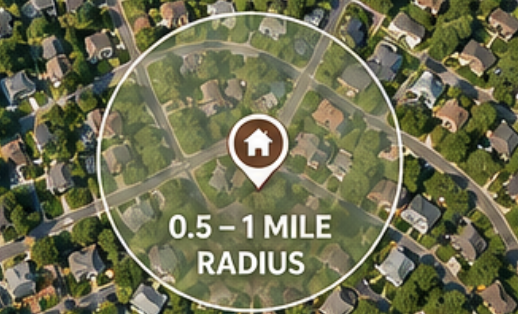
Location: Within approximately 0.5 to 1 mile of your property.
Timeframe: Homes that have sold within the past 180 days, sometimes expanding to 365 days depending on market conditions.
Age: Homes built around the same time as yours.
Style and floor plan: Properties with similar architectural styles and layouts.
These are starting points, not hard-and-fast rules.
For example, you wouldn't want to compare a ranch home to a two-story home, or a reverse 1.5-story to a split-entry home, if more similar options are available. They offer different layouts, functionality, and appeal to buyers.
The same applies to age. Comparing a brand-new construction home to a 50-year-old home might not give us an accurate picture of value unless we account for significant differences.
The goal is to compare apples to apples, not apples to oranges!
Step 2: Comparing Updates, Condition, and Finishes
Once we've narrowed down the location, age, and style, we look at the condition of each property.
This is where things get interesting!
Let's say we find two homes in the same neighborhood. They're both ranches, approximately 2,000 square feet, and built in the same year.
But there's one big difference.
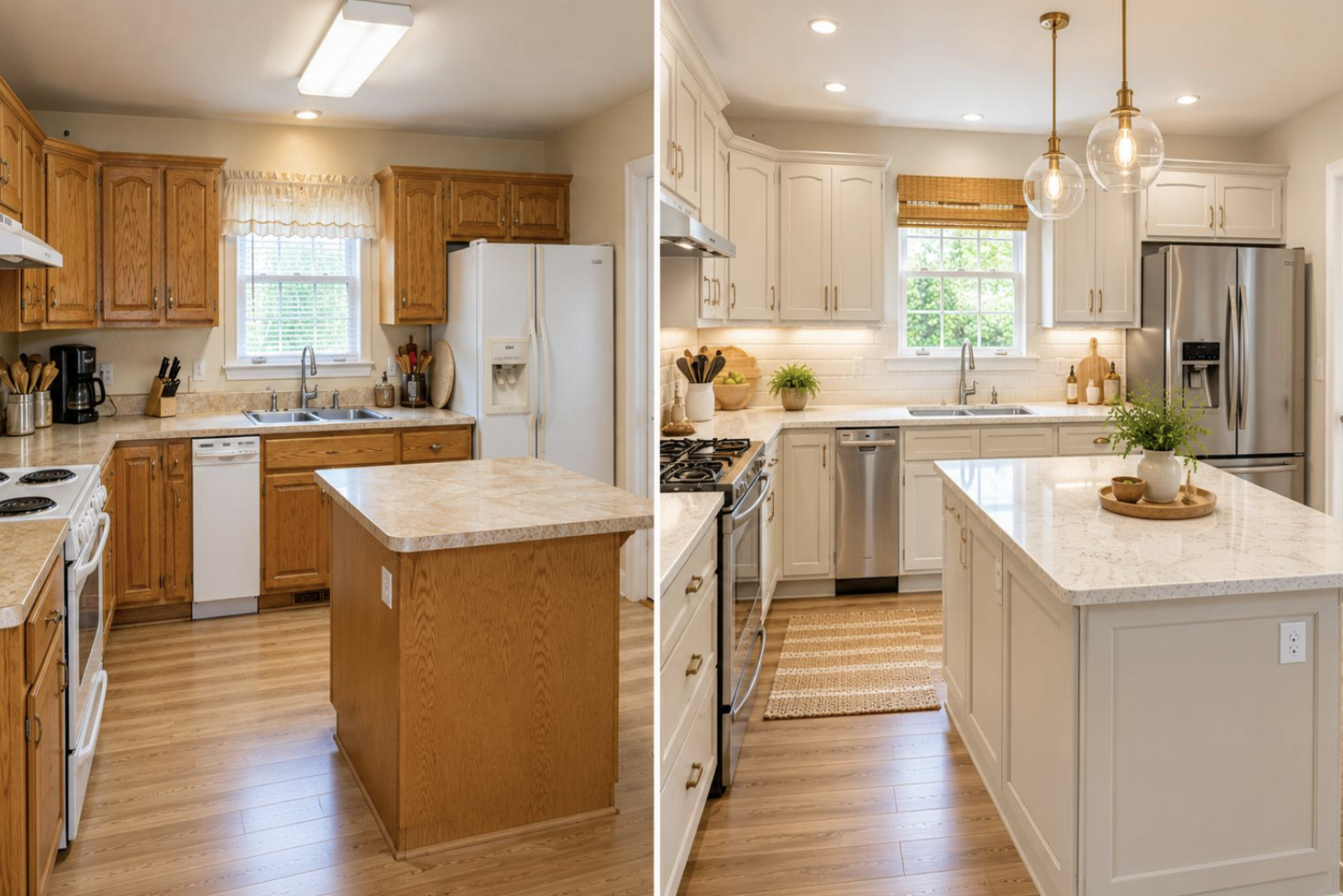
Home A: Has its original kitchen, laminate countertops, older flooring, outdated bathrooms, and needs some cosmetic work.
Home B: Has been completely renovated with quartz countertops, new cabinetry, updated bathrooms, modern flooring, and high-end finishes.
Would you expect these homes to sell for the same amount?
Probably not!
That's why we look beyond the basic property details and evaluate things like kitchen and bathroom updates, flooring, cabinetry, countertops, overall condition, and quality of materials.
Quartz countertops and laminate countertops aren't necessarily going to contribute the same value. A fully renovated property may attract a different level of buyer interest than one that hasn't been updated in decades.
However, here's something important to remember: Just because you spent $50,000 renovating your home doesn't automatically mean you've added $50,000 in market value.
We have to look at what buyers in your particular market are willing to pay for those improvements.
Step 3: Comparing Bedrooms, Bathrooms, and Square Footage
Next, we narrow our search further by looking at homes with similar:
Bedroom and bathroom counts
Finished living space
Basement finish and functionality
Garage spaces
Lot sizes and usable outdoor areas
A three-bedroom, two-bathroom house isn't always going to compete directly with a five-bedroom, four-bathroom house.
But even here, it's not as simple as adding a set dollar amount for every extra bedroom or bathroom.
We need to determine what those differences are actually worth to buyers in that particular area.
For example, an additional bedroom in one neighborhood may have a different impact on value than it would in another.
Did You Know? Not Every Room Can Be Counted as a Bedroom!
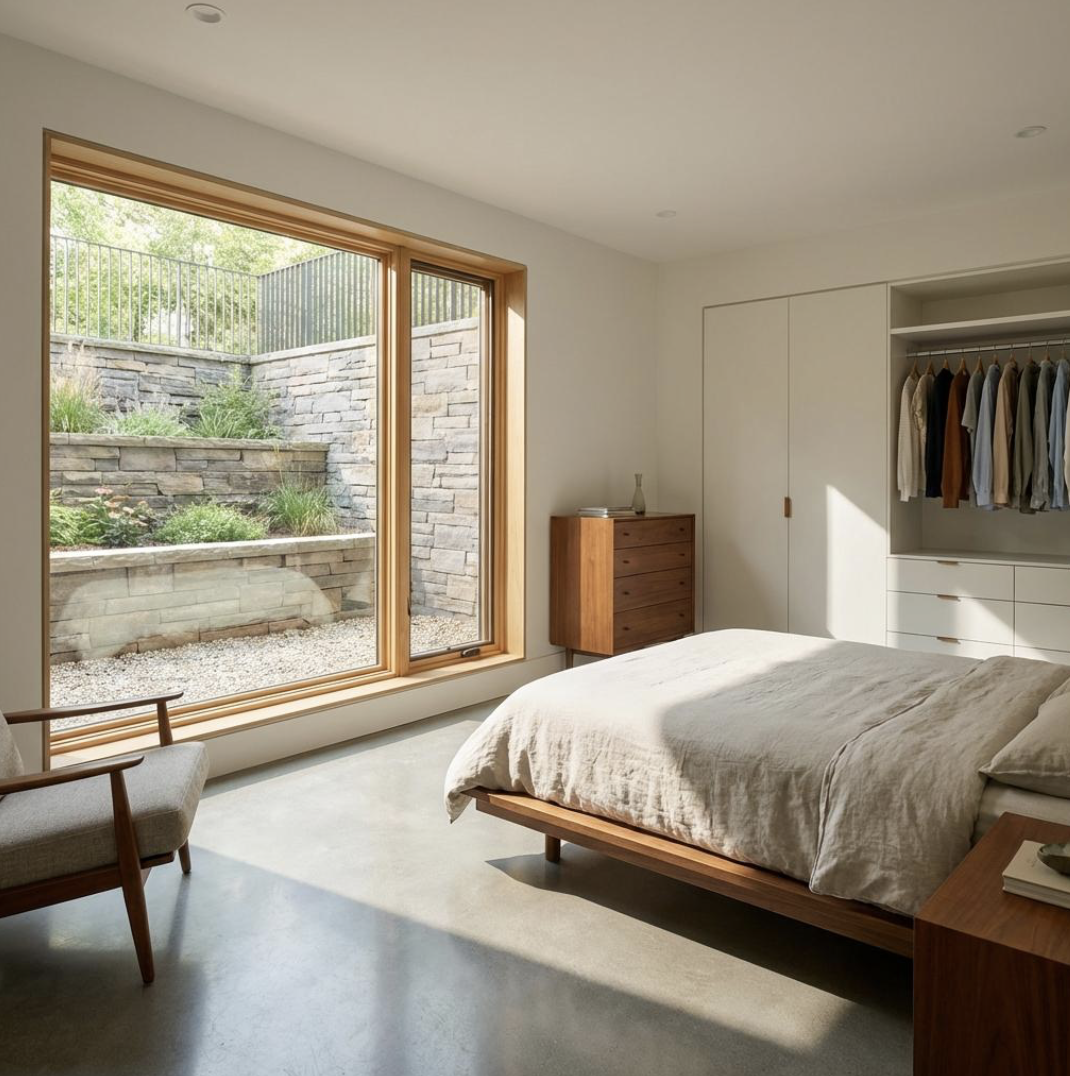
Picture from tierneyfoundationrepair.com
Here's something that surprises a lot of homeowners!
Just because a room has a bed in it doesn't automatically mean it qualifies as a bedroom when selling or appraising a home.
There are building and safety standards that help determine whether a room can legally be used as a bedroom.
In Missouri and Kansas, many communities follow versions of the International Residential Code (IRC), which generally includes these requirements:
1. Proper Access and Emergency Escape
A bedroom typically needs an interior access door and a separate emergency escape and rescue opening, such as an exterior window.
And not just any window will do!
For a typical code-compliant egress window:
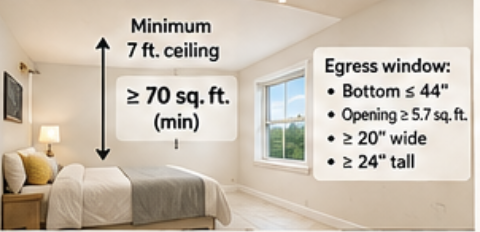
The bottom of the clear opening generally cannot be more than 44 inches above the floor.
The window must provide at least 5.7 square feet of clear, openable space, or 5 square feet for qualifying grade-floor openings.
The clear opening must be at least 20 inches wide and 24 inches tall, while also meeting the total opening-area requirement.
Why does this matter?
Because in an emergency, the opening needs to be large enough for someone to escape and for a firefighter wearing equipment to enter and assist.
2. Minimum Ceiling Height
A bedroom generally needs a ceiling height of at least 7 feet.
There can be exceptions for sloped ceilings, attics, and certain existing spaces, depending on the applicable building code.
3. Minimum Square Footage
Under commonly adopted residential building standards, a bedroom generally needs at least 70 square feet of floor space, with no horizontal dimension measuring less than 7 feet.
That means you can't necessarily take a tiny storage room, put a bed in it, and call it another bedroom!
4. Here's the One That Surprises People: A Closet Isn't Always Required!
Many homeowners believe a room absolutely must have a closet to qualify as a bedroom.
But that's not a universal building-code requirement!
A room can potentially qualify as a bedroom without a built-in closet, provided it meets the applicable requirements for size, access, safety, and other local standards.
Of course, having a closet can make the room more functional and appealing to buyers.
Why Does All of This Matter for Your Home's Value?
Let's say you have a three-bedroom home with an additional finished room in the basement.
If that basement room doesn't have proper emergency egress, it may not qualify as a legal bedroom, even if you've been using it as one for years.
And that can affect how the property is marketed, compared to other homes, and evaluated during an appraisal.
This is one reason I always pay attention to bedroom counts, basement finishes, ceiling heights, and functionality when evaluating a property's value.
Remember: Local building codes, MLS reporting rules, and appraisal guidelines aren't always identical. Requirements can also vary based on the age of the home and when improvements were made.
So before advertising that extra room as a bedroom, it's worth verifying that it actually qualifies!
Step 4: What Happens When There Aren't Any Good Comps?
This is one of my favorite parts of real estate because some properties really make you think outside the box!
In a typical subdivision, finding comparable homes can be fairly straightforward.
But what if you own five acres? Or a home with an unusual layout? Or a property that is completely different from everything around it?
That's when we have to expand our search.
For acreage properties, we might start by looking several miles out because larger properties are naturally more spread out.

For especially unique properties, it may be necessary to look in other areas with similar market characteristics, school districts, or even throughout the county.
Sometimes, we have to go even farther!
A Real-Life Example From My Experience
I once worked with an earth-contact home on acreage.
If you've never seen one, an earth-contact home is partially built into the ground, often with earth against some of its exterior walls.
These aren't exactly something you find in every neighborhood!
Trying to compare that property to a traditional two-story or ranch home wouldn't tell us the whole story.
Instead, we had to search for other earth-contact homes and eventually expand our search throughout the Kansas City area to find properties with similar characteristics.
That's why evaluating unique properties requires extra research and a deeper understanding of the market.
The best comparable isn't always the closest house. It's the house that most closely represents what buyers would consider an alternative to yours.
Step 5: Making Adjustments for Differences

Once we've found several comparable sales, we start comparing them side by side.
Here's the thing: no two houses are exactly alike.
One property might have an additional bathroom. Another might have a finished basement. Another could have a detached garage or a larger lot.
Appraisers account for these differences by making adjustments based on what the market indicates those features are worth.
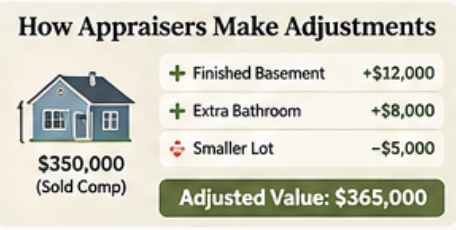
For example, if a comparable home sold for $350,000 but has a feature that makes it more valuable than your home, the appraiser may adjust that comparable's sale price downward.
If the comparable is missing a valuable feature that your home has, an upward adjustment may be appropriate.
These adjustments aren't just random numbers. They should be supported by market data.
It's also important to understand that an additional garage, bathroom, or finished basement doesn't necessarily have the same value in every neighborhood.
Once the differences are accounted for, the adjusted comparable sales help us narrow down a reasonable value range.
Step 6: Why Price Per Square Foot Can Be Misleading
This is probably one of the biggest misconceptions I see homeowners make!
Let's say a house down the street sold for $200 per square foot.
You have 2,500 square feet, so you multiply:
2,500 × $200 = $500,000
Does that automatically mean your house is worth $500,000?
Absolutely not!
Here's why.
Not all square footage is created equal.
One home might have basic laminate flooring, original cabinets, and builder-grade finishes.
Another might have custom cabinetry, beautiful hardwood floors, luxury bathrooms, and, heck, maybe even a gold toilet!
They're both 2,500 square feet, but that doesn't make them equal in value.
We also have to consider the difference between above-grade and below-grade finished living space, the layout, the quality of construction, and how functional the space actually is.
Price per square foot can be a helpful reference point, but it should never be the only method used to determine a home's value.
Step 7: Understanding the Current Market
Even after finding great comparable properties, we still have another important factor to consider.
What's happening in the market right now?
A home that sold six months ago might have sold under completely different market conditions.
We look at things like:
How many similar homes are currently for sale?
How quickly are homes selling?
Are sellers reducing their asking prices?
Are homes selling above or below their asking prices?
Are buyers receiving concessions?
Is the market appreciating, declining, or staying relatively stable?
We also look at pending sales and active listings to understand the competition, although closed sales provide important evidence of what buyers have actually paid.
This is why your home's value isn't necessarily the same today as it was a year ago.
Real estate values change with the market!
Step 8: What's Changing With Appraisals in November 2026?
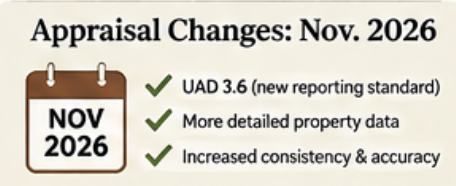
Here's something interesting that many homeowners might not know!
As of November 2, 2026, Fannie Mae and Freddie Mac have introduced a major change to the way residential appraisal information is reported.
It's called Uniform Appraisal Dataset (UAD) 3.6, and it brings a more detailed, standardized, data-driven approach to appraisal reporting.
Rather than relying on the older standardized appraisal forms, the new system uses a flexible report that captures more structured information about the property and its characteristics.
The goal is to improve consistency, make property details easier to analyze, and provide clearer information about how an appraisal is supported.
Some lenders have been granted temporary extensions to transition to the new reporting requirements.
This doesn't mean the basic principles of determining value have completely changed. Appraisers still analyze comparable properties, market conditions, and property differences.
But the way that information is collected and reported is becoming more comprehensive and standardized.
So, What's the Difference Between a Realtor's CMA and an Appraisal?
While real estate agents and appraisers use many of the same principles to evaluate properties, we serve different purposes.
A Comparative Market Analysis (CMA) is prepared by a real estate agent to estimate a property's market value and help homeowners make decisions about selling, buying, or understanding their equity.
An appraisal is a formal valuation completed by a qualified appraiser, often used by lenders when someone is purchasing or refinancing a home.
Both involve market research and comparable sales, but an appraisal follows specific professional standards and the requirements of the assignment.
And neither is a guarantee of what a home will ultimately sell for.
At the end of the day, a home's market value is heavily influenced by what buyers are willing to pay and what comparable properties support.
Final Thoughts: Your Home Is More Than Just a Number on a Website
Online home estimates can be fun to look at, but they don't always tell the full story.
An automated estimate may not know that you've remodeled your entire kitchen, finished your basement, replaced outdated flooring, or made other improvements that affect your property's appeal.
And it might not fully capture the unique characteristics of your land, location, or floor plan.
That's why I believe having someone actually evaluate your property and understand your local market is so valuable.
Whether you're thinking about selling, refinancing, exploring a HELOC, or simply curious about how your investment has grown, understanding your home's value can help you make more informed financial decisions.
Curious what your home is worth in today's market?
I'd be happy to put together a complimentary market analysis for you! And if you want a more accurate picture, I can come see your property in person, evaluate your updates, and compare it to similar homes that have recently sold.
After all, your home is likely one of your biggest investments. You deserve to know how it's performing!
— Aubri Blaize | Up to Blaize Real Estate


